AI Transformation Is an Operating Model Change, not a Software Purchase
A client came to us last year with a familiar story: they'd licensed an AI platform, trained a small team, and run a promising pilot on regulatory document review. The pilot went well. Then it ended, the team moved on to other priorities, and the platform sat mostly unused. The technology had worked. The organization hadn't changed.
That gap, between a successful pilot and an actual shift in how work gets done, is where most AI transformation efforts quietly die.
Why pilots don't become practice
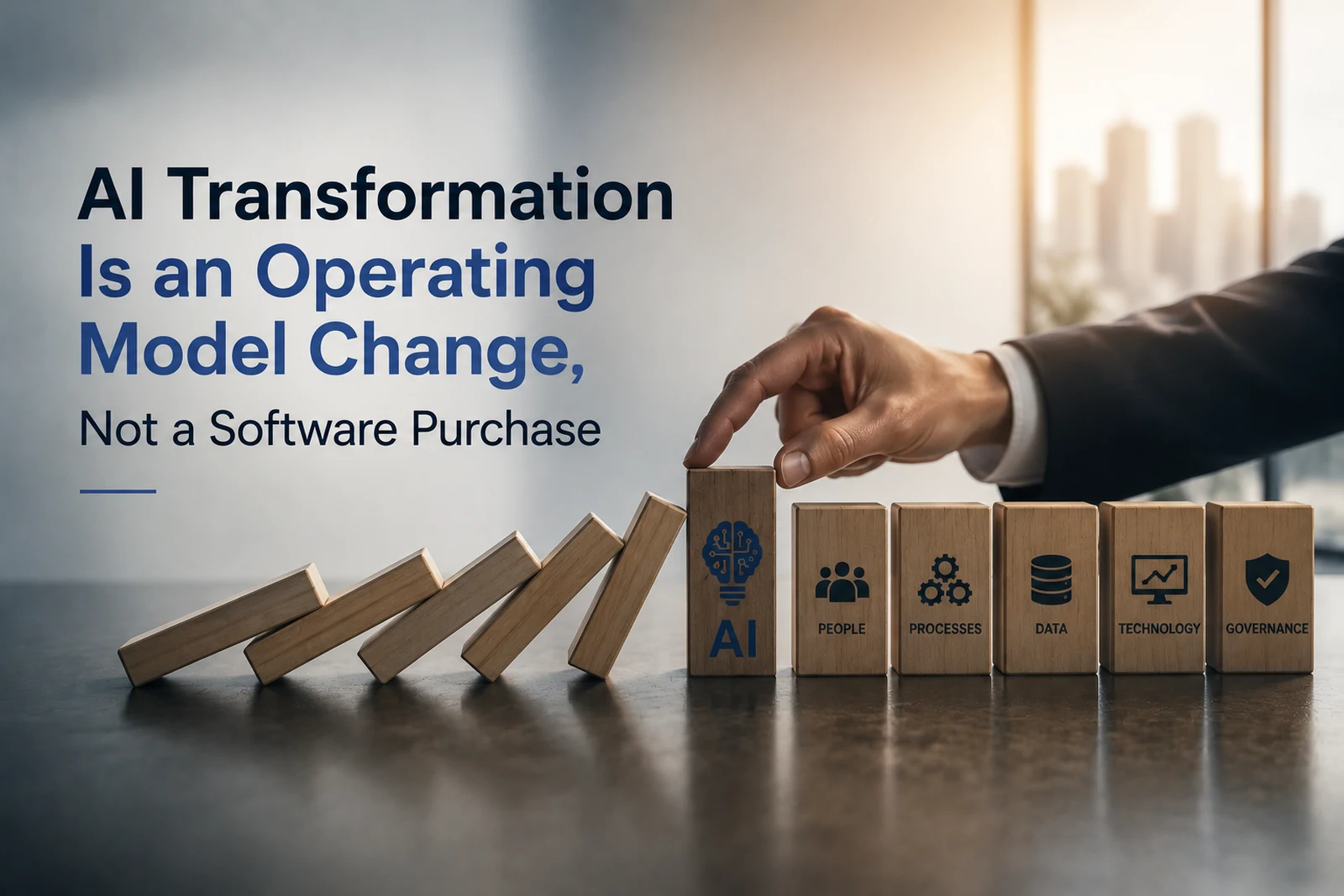
A pilot proves a model can work. It rarely proves an organization is ready to run on it. Ownership stays unclear, workflows don't get redesigned around the new capability, and once the pilot budget runs out, so does the momentum. The technology was never really the constraint. The operating model was.
Governance isn't optional anymore
Under the EU AI Act and standards like ISO 42001, governance can't be something you retrofit after a system is already live. Risk classification, documentation, human oversight, and accountability need to be part of the initial design, not a compliance exercise that starts after legal asks questions. Organizations that treat governance as a launch requirement move faster in the long run, because they're not rebuilding systems mid-flight to satisfy an audit.
Sovereignty changes the calculus
Where your data lives, who can access it, and whose infrastructure your AI models run on are no longer back-office details, they're strategic decisions. For organizations operating across Europe and Africa in particular, data residency and vendor independence directly affect regulatory exposure and long-term flexibility. Sovereign infrastructure isn't about avoiding the cloud; it's about not outsourcing control over your own transformation.

Define, build, execute
The engagements that actually change how a business runs tend to follow the same three stages:
The standard we hold ourselves to
We call it Productive, Sovereign, Resilient, and it's less a tagline than a checklist. Productive means the use case ties to a real outcome. Sovereign means you control the infrastructure and data. Resilient means the governance holds up under regulatory scrutiny, not just internal review.
AI transformation isn't a purchase decision. It's an operating model decision that happens to involve AI. Organizations that treat it that way are the ones still using their AI capability a year later, not just the ones with the best pilot deck.